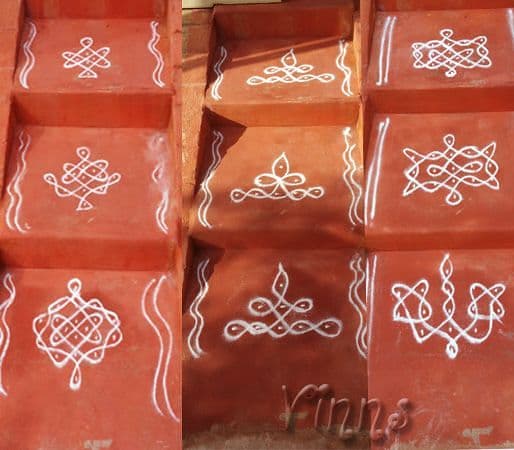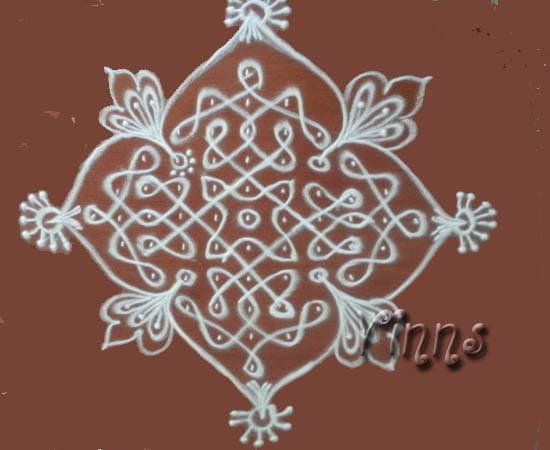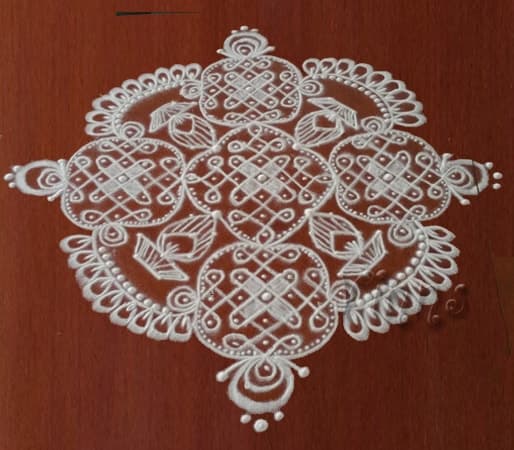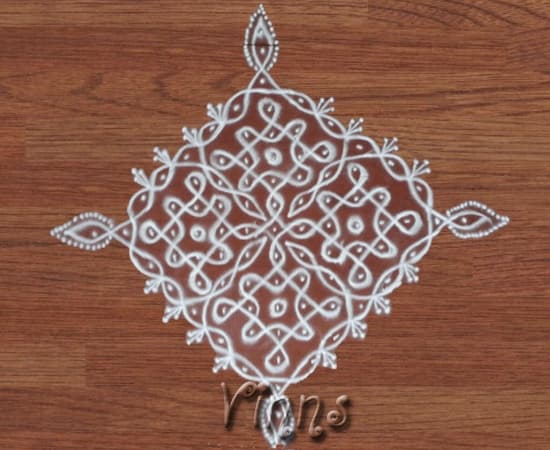
Mastering Sikku Kolam: The Complete Guide to Continuous Knots (Kambi Kolam)
A comprehensive masterclass on Sikku Kolam (Kambi Kolam): loop mechanics, the sacred Brahma Mudi infinite knot, mathematical Eulerian paths, and step-by-step practice routines.
The Living Mystery of South Indian Sikku Kolam
Among the diverse genres of traditional South Indian floor art,Sikku Kolam (also referred to asChikku Kolam,Kambi Kolam, orNeli Kolam) occupies the highest echelon of mathematical sophistication and devotional elegance. Unlike direct-connect dot Rangolis where straight lines link dot to dot, Sikku Kolam obeys a strict geometric mandate:the lines must never touch or intersect the dots. Instead, fluid, unbroken curves weave around, encircle, and loop through an interlaced matrix of dots, returning to their origin to create a seamless, closed topological circuit.
The Sacred Symbolism of Brahma Mudi (The Infinite Knot)
In traditional Tamil culture, a continuous loop without visible beginning or ending is revered asBrahma Mudi - the divine knot of cosmic infinity. Historically, women drew Brahma Mudi patterns at dawn during festival mornings and Fridays to represent the unbroken continuum of time, karma, and rebirth (Samsara). Crucially, tradition dictates that threshold kolams should never have open, unresolved ends; an unbroken perimeter safeguards the domestic sanctuary, preventing negative vibrations from permeating the household while creating an energized, consecrated space for divine grace.
Mathematical Beauty: Eulerian Cycles & Ethnomathematics
Mathematicians and computer scientists worldwide have long studied Sikku Kolam as a premier example ofEthnomathematics. The pattern conforms to graph theory principles:
- Eulerian Circuits: Many classic Sikku designs can be traced continuously in a single unbroken stroke without lifting the hand or retracing an edge.
- Rotational Symmetry (C4 Group): A single quadrant's curve algorithm repeats across 90°, 180°, and 270° rotations around the central anchor point.
- Array Topology: The dots act as repulsive potential fields that guide the curves into harmonic sine-like trajectories.
Step-by-Step Drawing Method: From Foundation to Finish
To execute a classic 7-to-1 interlaced Sikku pattern flawlessly, adhere to this time-tested sequence:
- Preparing the Floor: Lightly sprinkle water mixed with natural cow dung or a pinch of turmeric to sanitize the courtyard floor. Allow it to settle into a clean, moist, matte finish.
- Dot Alignment: Lay down the 7-to-1 interlaced (Santhu Pulli) grid. Start with 7 dots in the center row. In each subsequent row above and below, place one dot fewer in the interstitial valleys (7, 6, 5, 4, 3, 2, 1). Ensure equal spacing.
- The Central Anchor Loop: Locate the 4 innermost dots forming a diamond. Draw a smooth central diamond loop that wraps around these dots without grazing them.
- Corner Petal Weaving: Move to each cardinal corner (North, South, East, West). Loop your powder stream smoothly around the outer terminal dots, returning inward to interlock with the central core.
- Checking Crossings: Verify that each line crosses over or under adjacent strands with uniform curvature. Avoid jerky 90-degree corners; let the curves flow naturally like flowing water.
- Kaavi / Semman Border: Frame the entire completed Sikku Kolam with a perimeter border of red ochre (Semman) to heighten contrast and seal the sacred boundary.
Tips for Flawless Powder Control (The Two-Finger Pinch)
The signature mark of a master Kolam artist is stroke consistency. Hold raw rice powder (Arisi Maavu) between the thumb pad and the middle/index fingers (Alankara Mudra). Rather than sprinkling from above, keep your fingers positioned just one inch off the ground. Gently roll the thumb against the fingers with a gentle squeezing rhythm, releasing a steady, velvety white ribbon. With regular daily practice, muscle memory will take over, transforming the drawing into a calming, meditative morning ritual.
Related Traditional Patterns
Similar geometries, symmetry types, and festive floor art styles