The Sacred Geometry of Kolam: Mathematics, Matrices & Ethnomathematics in Tamil Culture
An in-depth exploration of the mathematical brilliance embedded in traditional Tamil Kolams: coordinate arrays, dihedral symmetry groups (C4 and D4), recursion, and computational topology.
Kolam: The Convergence of Ritual Art and Advanced Geometry
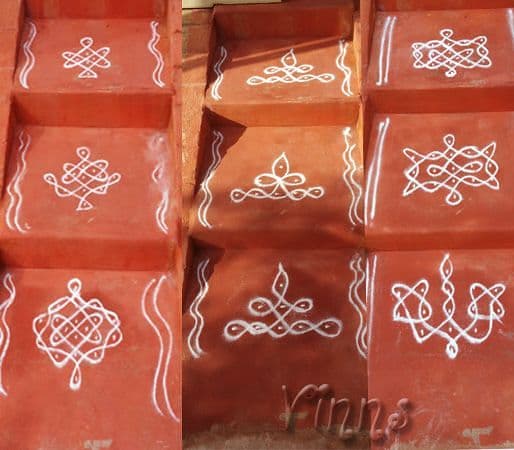
For centuries, the women of Tamil Nadu have walked out onto their thresholds at dawn, armed only with a pinch of rice flour and an intuitive grasp of higher geometry. Without formal training in calculus, linear algebra, or graph theory, traditional practitioners routinely generate complex topological knots, affine transformations, fractals, and symmetric crystal lattices. This extraordinary living tradition represents one of the world's most sophisticated manifestations ofEthnomathematics.
Coordinate Systems: Neri Pulli vs. Santhu Pulli
Every structured Kolam begins with a discrete dot array (Pulli Varisai), establishing a spatial coordinate system that governs every stroke:
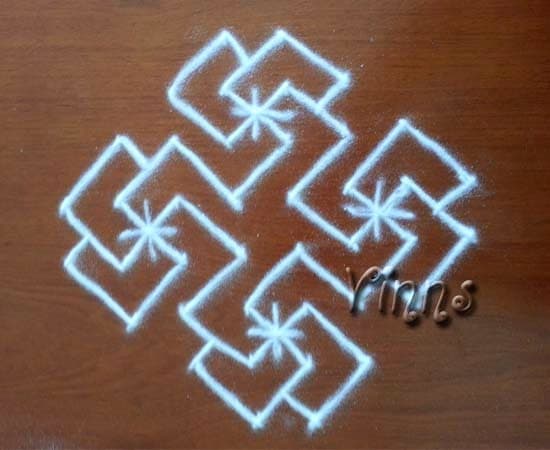
- Neri Pulli (Cartesian Orthogonal Grid): Dots are arranged in perpendicular rows and columns forming a rectangular or square grid ($m imes n$). Every point $(x, y)$ has four orthogonal neighbors. This grid governs line kolams, swastika matrices, and temple border architectures.
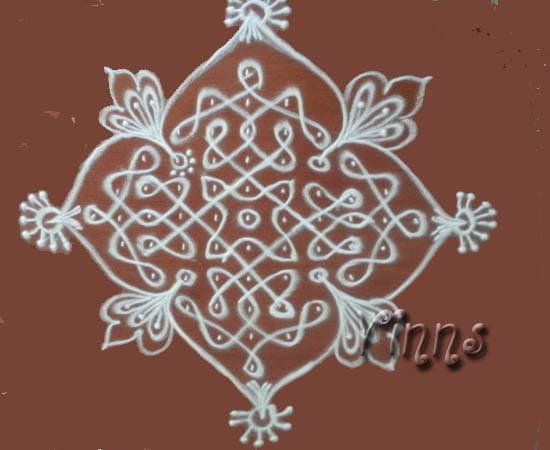
- Santhu Pulli / Idukku Pulli (Hexagonal / Triangular Interlaced Grid): Each successive row is offset by half the dot spacing, with dots positioned in the interstitial depressions of adjacent rows. This generates an equilateral triangular lattice ($A_2$ root system), providing 6 isometric directions of movement and enabling the fluid 60° and 120° loop turns characteristic of Sikku Kolams.
Symmetry Groups in Floor Art: D4 and Cyclic Invariance
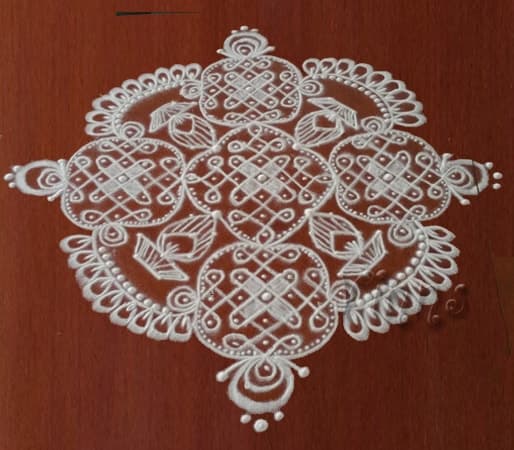
Kolam designs frequently exhibit invariance under theDihedral Group $D_4$ (the symmetry group of the square), which includes:
- 4 Rotational Symmetries: Rotations by 0°, 90°, 180°, and 270° around the centroid.
- 4 Reflectional Symmetries: Reflections across the horizontal axis, vertical axis, and both primary diagonal bisectors.
In ritual belief, high-order symmetry creates perceptual balance and psychological calm for anyone entering the doorway. Neurologically, visual symmetry triggers immediate aesthetic appreciation, bilateral hemisphere coherence, and a sense of sacred order.
Algorithmic Recursion & Formal Language Theory
In 1982, computer scientists Gift Siromoney and Rani Siromoney demonstrated that Kolam patterns can be formally generated usingPicture Languages andLindenmayer Systems (L-Systems) - the very mathematical formalisms used to model plant growth and recursive computer graphics. By defining a minimal set of primitive stroke gestures (loops, arcs, turns) and recursive substitution rules, an infinite variety of intricate, self-similar floor tapestries can be computed.
Preserving an Intellectual Heritage
Far from being a vanishing folk tradition, Kolam represents an enduring repository of indigenous scientific thought. As modern educators seek hands-on ways to teach spatial reasoning, algorithmic thinking, and computational geometry, the humble doorstep Kolam stands as a monumental pedagogical tool, reminding us that sacred art and rigorous science are two sides of the same sacred coin.
Related Traditional Patterns
Similar geometries, symmetry types, and festive floor art styles