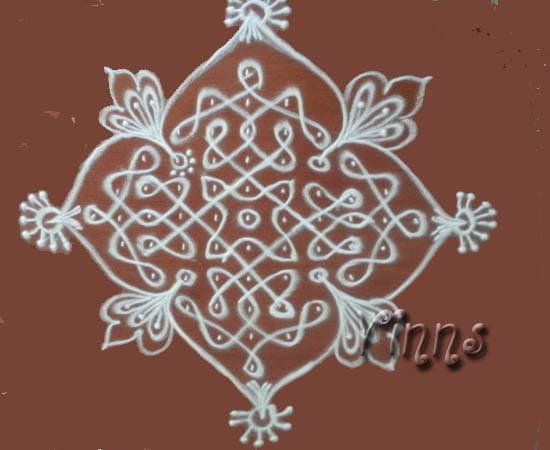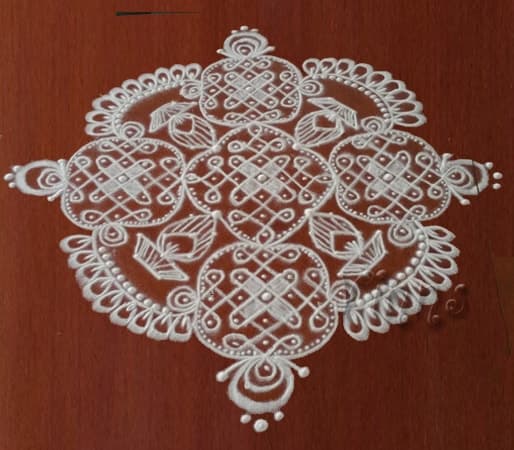
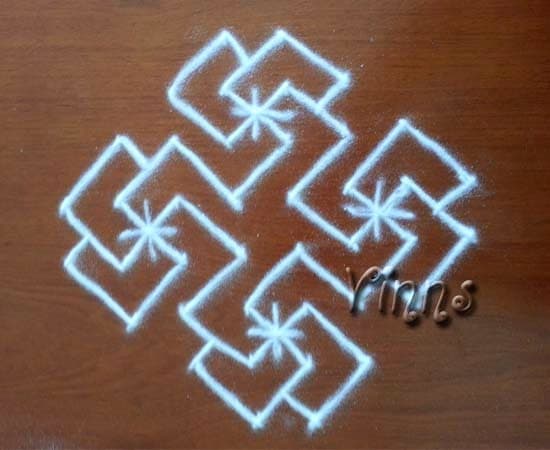
Simple 4 Petals Flower Kolam || Easy 8 dots Karthigai Deepam || 8x8 dots Diya Rangoli
A 8x8 dots with 4 petals flower along with lamps.
Related Traditional Patterns
Similar geometries, symmetry types, and festive floor art styles
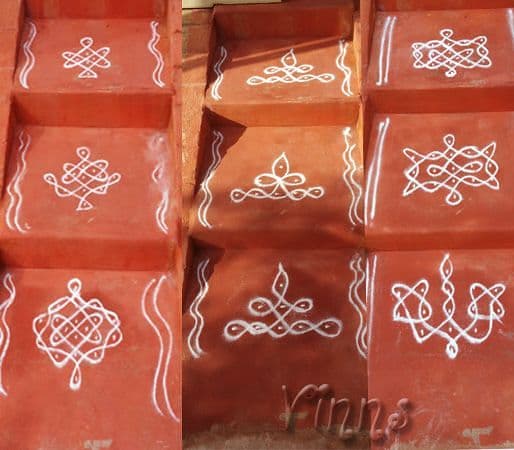
A 8x8 dots with 4 petals flower along with lamps.
Similar geometries, symmetry types, and festive floor art styles
Anchor a piece of thread at your center point and lightly trace 3 to 5 concentric circular guidelines with faint chalk on the clean floor.
Position a magnificent whole lotus blossom or a tight, dense rosette of vibrant yellow marigold petals at the very center as the visual anchor.
Fill each concentric ring with contrasting fresh petals (orange marigold, pink rose, purple orchids, and white jasmine), packing petals closely for a rich velvety texture.
Surround the outer floral rim with dark green mango leaves or bilva leaves. Place glowing brass or terracotta oil lamps (agal vilakku) at cardinal compass points.
"Simple 4 Petals Flower Kolam || Easy 8 dots Karthigai Deepam || 8x8 dots Diya Rangoli" stands as an exquisite embodiment of traditional South Indian floor artistry, chronicled as part of Vinns' comprehensive cultural archive. Drawn at the auspicious threshold of the home during Brahma Muhurtham (the tranquil pre-dawn hours), this pattern harmonizes timeless spiritual philosophy with sophisticated mathematical geometry. Across generations of matrilineal heritage in Tamil Nadu, Karnataka, and Andhra Pradesh, drawing such intricate geometric patterns on a freshly swept and cleansed entrance is believed to invite Lakshmi Kataksham (divine prosperity, peace, and abundance) while warding off negative domestic energies.
THE SACRED DAWN TRADITION OF TAMIL THRESHOLD ART
In South Indian aesthetic philosophy, a Kolam is never merely a decorative drawing; it is a sacred daily ritual of generosity and cosmic gratitude. Drawn with freshly ground raw rice flour (Arisi Maavu), this artwork performs Bhootha Yajna—the noble duty of offering food to ants, birds, and tiny creatures that share our ecological habitat. The motif of Simple 4 Petals Flower Kolam || Easy 8 dots Karthigai Deepam || 8x8 dots Diya Rangoli emphasizes the sacred cosmic order, where individual elements unite into a seamless visual prayer. The threshold of the house (Vasal Padi) acts as the sacred boundary between the outer mundane world and the sanctified inner home; by gracing this threshold with Simple 4 Petals Flower Kolam || Easy 8 dots Karthigai Deepam || 8x8 dots Diya Rangoli, the home welcomes harmonious energies, auspicious visitors, and spiritual tranquility.
GEOMETRIC TOPOLOGY & COORDINATE BLUEPRINT
Balanced rectangular grid (8x8) with rows and columns perfectly aligned in perpendicular symmetry.
Maintains balanced energy flow across radial and bilateral reflection planes, creating perceptual equilibrium.
TRADITIONAL EXECUTION PROTOCOL FROM FOUNDATION TO PERIMETER
Begin before sunrise by washing the entrance or designated floor area with clean water. Traditionally, a light spray of cow-dung water or turmeric water is sprinkled to naturally disinfect and cool the floor, creating a pristine, matte canvas that helps the white rice flour adhere crisply.
Carefully place the dot array (8x8). Maintain a consistent distance (approximately 1 to 1.5 inches) between adjacent dots using your index finger as a natural spacer. For interlaced patterns, place each successive row in the intermediate depressions of the previous row to preserve geometric equilibrium.
MATERIALS, RICE FLOUR CONSISTENCY & FLOW ERGONOMICS
Mastering the tactile art of Kolam depends upon the proper hand ergonomics known as the Alankara Mudra (the two-finger pinch). The artist takes a pinch of finely milled raw rice flour between the thumb and the middle/index fingers, holding the hand a few inches above the floor. By gently sliding the thumb against the finger pads with steady, rhythmic micromovements, a continuous, unbroken velvety stream of powder is released onto the ground. While modern practitioners often use powdered limestone or fine white river stone powder (Kolapodi) for everyday practice on concrete, traditional festival rituals call for authentic rice flour or wet rice paste (Maa Kolam) applied with a folded cloth to produce brilliant, durable ceremonial lines.
COMMON QUESTIONS FOR PRACTITIONERS & LEARNERS
Simple 4 Petals Flower Kolam || Easy 8 dots Karthigai Deepam || 8x8 dots Diya Rangoli is a time-honored South Indian threshold pattern designed to invoke auspiciousness, peace, and abundance (Lakshmi Kataksham). Drawn traditionally with raw rice flour, it combines sacred geometry with the ancient ecological virtue of feeding small birds and insects.
Vinns is a traditional South Indian Kolam artist and researcher passionate about preserving the mathematical elegance of Pulli matrices, Brahma Mudi continuous knots, and festival threshold traditions. Every pattern on this blog is drawn by hand.
Start from the central motif—whether a blooming lotus bulb, an auspicious star, or a primary geometric core. Construct the foundational center with steady two-finger flow, ensuring all four quadrants maintain mirror symmetry.
Draw the outer petal extensions, curved borders, or corner flourishes. Maintain uniform thickness across all strokes by regulating the powder pressure between your thumb and index finger.
Complete the artwork by tracing a bold border around the design. On Fridays, Tuesdays, and festive mornings, frame the perimeter with bright red ochre (Semman / Kaavi) powder. In Tamil tradition, the contrasting crimson border symbolically locks in the positive spiritual energy and sanctifies the threshold as an inviolable sacred sanctuary.
This design is built upon a 8x8 grid (Neri Pulli (Straight Orthogonal Cartesian Grid)). Proper spacing between the dots is essential to ensure that curves and loops weave symmetrically across all quadrants.
Simple 4 Petals Flower Kolam || Easy 8 dots Karthigai Deepam || 8x8 dots Diya Rangoli is well-suited for intermediate practitioners who are comfortable with foundational dot grids and seek to refine their loop curvature, corner symmetry, and continuous line control.
Red ochre (Semman or Kaavi) contains natural iron oxide and represents the earth and divine feminine energy (Shakti). Framing a white Kolam with red borders creates a visually striking contrast, symbolically seals the domestic sanctuary, and wards off negative energies from crossing the threshold.